
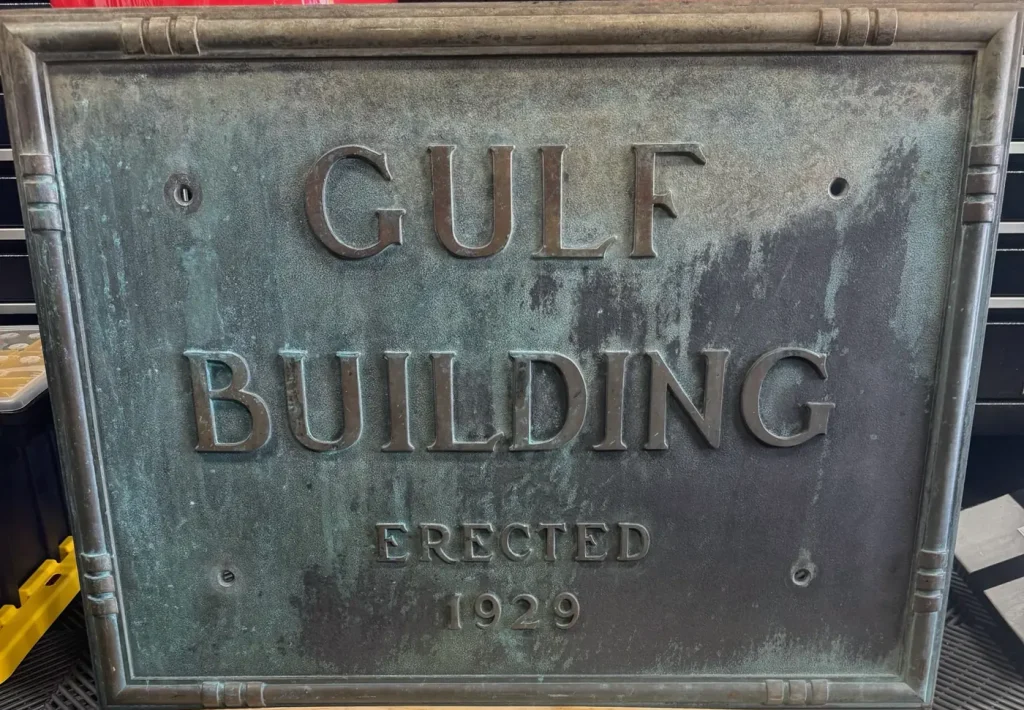
The original 1929 Gulf Building plaque is the cast-bronze name tablet that hung beside the main entrance of the Gulf Building at 712 Main Street in Houston, the Art Deco tower Jesse H. Jones completed in 1929 with Gulf Oil as its anchor tenant. Cast by the A.J. Bayer Co. of Los Angeles, it measures 37 by 28 inches, weighs 103 pounds, and is now part of The Shop South Collection.
What was the Gulf Building in Houston?
When it was finished in 1929, the Gulf Building was the tallest building in Houston, and it held that title until 1963. It was developed by Jesse H. Jones, the Houston builder, banker and newspaper publisher who went on to run the Reconstruction Finance Corporation for Franklin D. Roosevelt. The design is credited to Alfred C. Finn, working with Kenneth Franzheim and J. E. R. Carpenter. The steel-framed tower has 37 floors and stands about 430 feet tall, rising from a six-story base and stepping back as it climbs.
Jones broke ground in the late summer of 1927 on the corner of Main Street and Rusk Avenue, and steel started going up on February 16, 1928. By the time the Democratic National Convention came to Houston that summer, the frame was already part of the skyline. The first tenant, the Sakowitz Brothers store, moved in on April 16, 1929, and by August 1 every tenant except the bank was in place.
Why is it called the Gulf Building?
Gulf Oil was the tower’s main office tenant. The company signed a 20-year lease for floors 7 through 19, with its executive offices on the 11th, 16th and 17th floors, and ran its regional headquarters from the building until 1982. The other original tenants were Jones’s National Bank of Commerce and the Sakowitz Brothers store, which took more than 65,000 square feet on the lower floors.
For eight years the Gulf name was also on the roof. A rotating Gulf sign went up in May 1966 and was taken down in March 1974.
What does the Gulf Building plaque say?
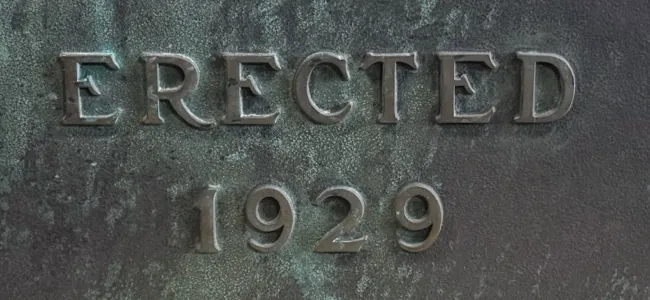
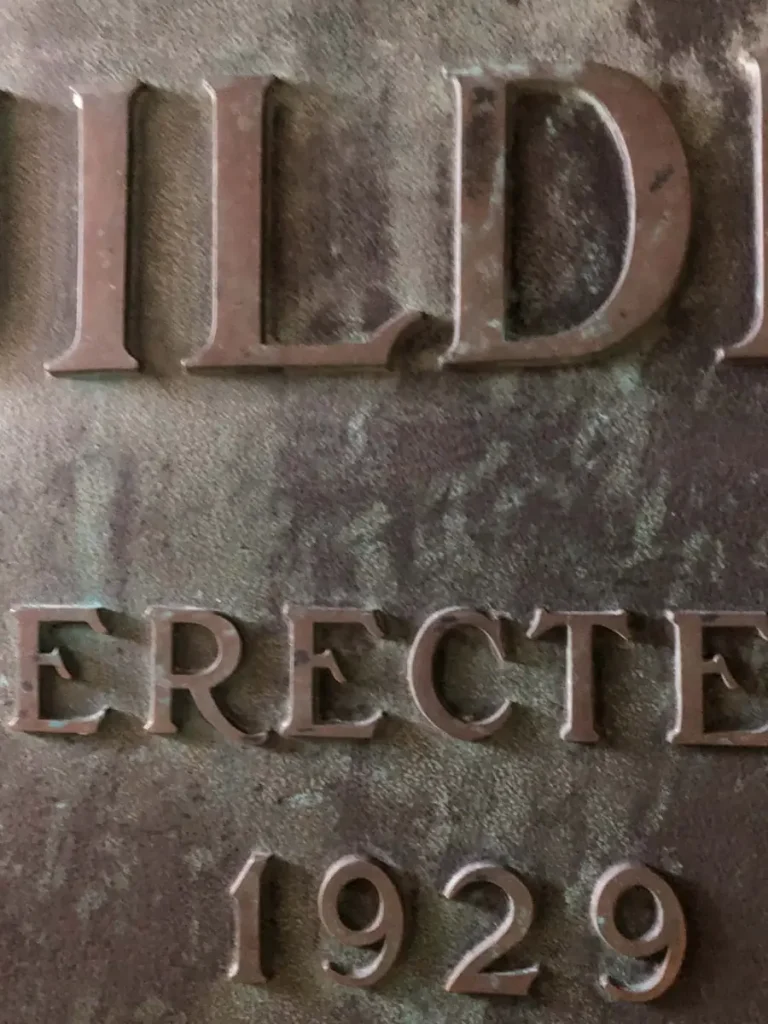
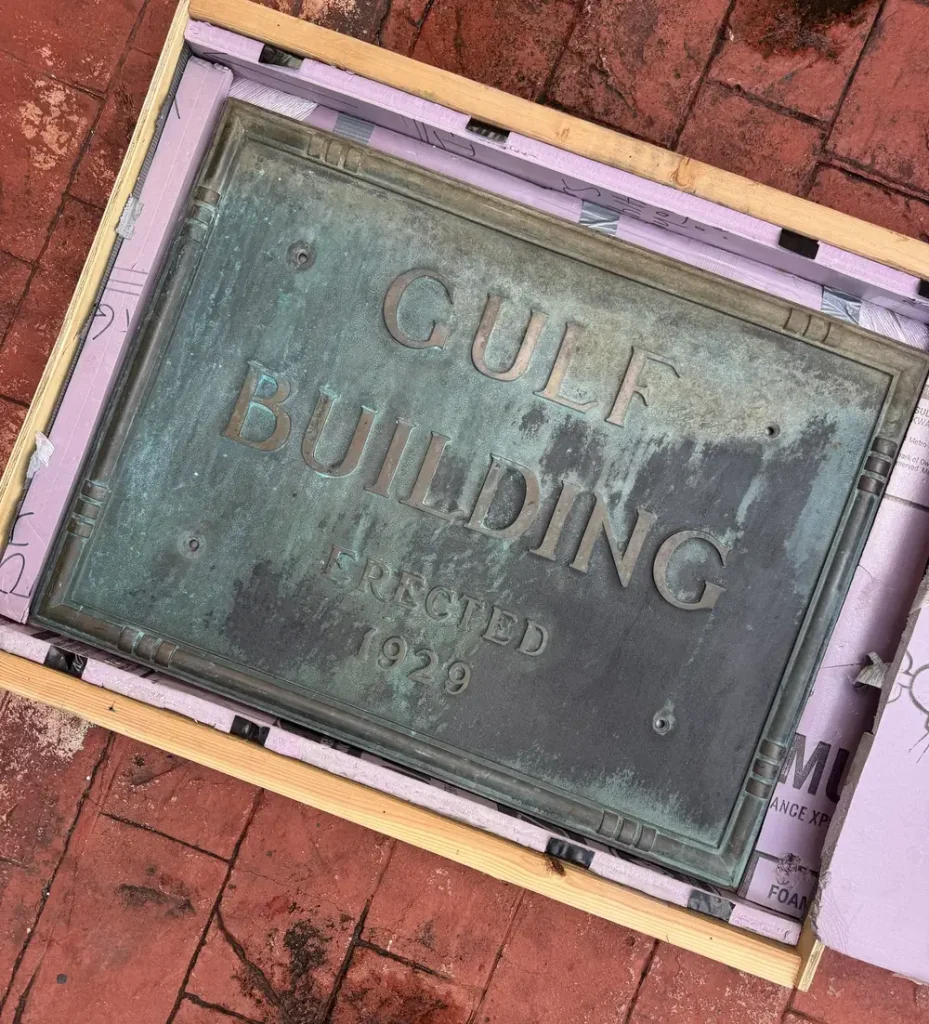
The wording is short and plain. In raised letters it reads GULF BUILDING, with ERECTED 1929 in smaller type beneath. There is no dedication, no list of names and no company slogan. It is the building’s name tablet, the sign that told people coming in off the sidewalk they were at the right door.
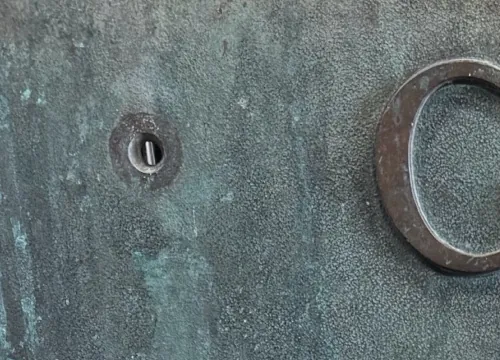
The face sits inside a raised molded border, broken at intervals by banded details along each edge. Four countersunk holes through the face held it to the wall.
Who made the plaque?
The maker’s mark is cast into the back of the bronze in small raised letters: A.J. BAYER CO. over LOS ANGELES.
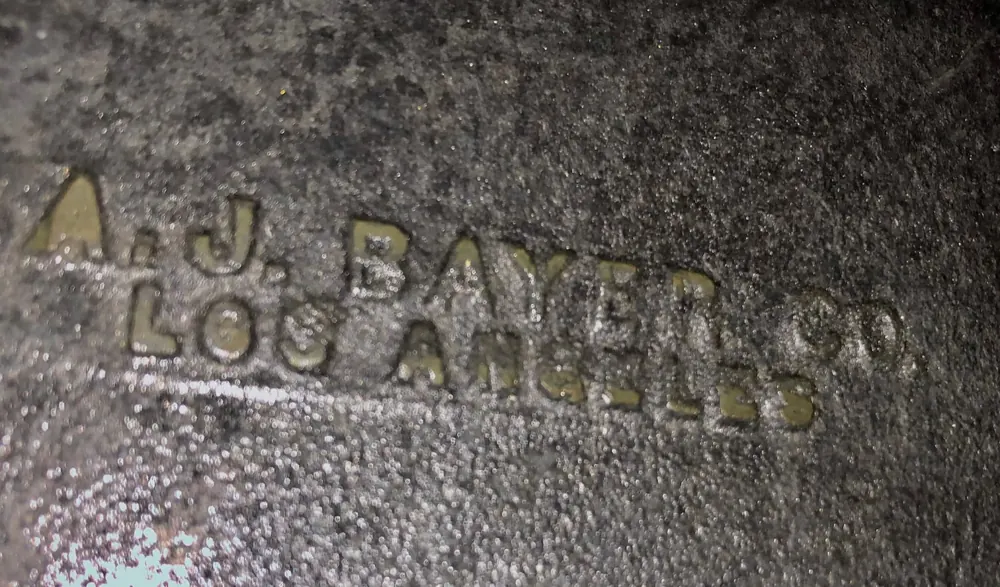
A.J. Bayer Co. was a Los Angeles architectural metal firm. A later company advertisement gives its address as 2300 East Slauson Avenue, describes it as doing “Architectural Metal Work Since 1902,” and shows metal lettering it made for the Los Angeles Memorial Coliseum and Bullock’s Pasadena. Little else about the firm turns up today, which makes the mark on this plaque a useful record in its own right. A Los Angeles shop casting the name tablet for a Houston tower is one of the details I find most interesting about this piece.
Where did it hang on the building?
The plaque was mounted at the building’s main entrance, on the left as you approached the front doors from the sidewalk, about 8 to 10 feet off the ground. Anyone walking in that way from 1929 on would have passed beneath it.
How did the plaque leave the Gulf Building?
No record of the plaque’s removal has turned up, but the building’s history points to a likely window. Gulf moved its regional headquarters out in 1982, and two years later Gulf Oil itself was acquired by Chevron. The tower became known by the name of its other long-time occupant, Texas Commerce Bank, which had grown out of Jones’s National Bank of Commerce and was headquartered there. Once Gulf was gone, a bronze tablet reading GULF BUILDING no longer matched the name on the door. My read is that it came down during that changeover in the 1980s, before or during the bank’s restoration of the building late in the decade. That is an informed guess from the timeline, not a documented fact.
What we do know is where it turned up. A collector went out to a man’s property in the country to buy a couple of Gulf gas pumps. The owner had run several Gulf stations in Houston years ago, and along with the pumps, he had this plaque.
How did it come to The Shop South?
I’ve collected Gulf for years, and this one came down to being in the right place at the right time. The plaque came up during a trade of rare gas pump globes between two other collectors, and I was offered it as part of that deal. It arrived in December 2025, packed in a wooden crate with foam. The collector I dealt with had written “Congrats Dan, Merry Christmas” on one of the crate boards.
How do we know it is the original?
Several things line up. The plaque is solid cast bronze, 103 pounds, with the maker’s mark cast into the back rather than stamped or added later. Its patina is the uneven green and brown that comes from decades outdoors, and the four countersunk mounting holes are what you’d expect on a tablet bolted to an exterior wall. It also came with a clear chain of ownership: from a Houston Gulf station owner, to the collector who bought his pumps, to me.
Where is the plaque now?
The plaque is part of The Shop South Collection and is not for sale. It will be displayed as a centerpiece of my Gulf collection, and it can be seen in person in Delray Beach, Florida, by appointment.
Gulf Building timeline
| Year | Event |
|---|---|
| 1927 | Jesse H. Jones breaks ground at Main Street and Rusk Avenue |
| 1928 | Steel goes up (February 16); the frame stands over the Democratic National Convention |
| 1929 | First tenant moves in (April 16); the Gulf Building is complete, with Gulf on floors 7 through 19 |
| 1963 | The Exxon Building passes it as Houston’s tallest |
| 1966 | A rotating Gulf sign goes up on the roof (May) |
| 1974 | The rooftop Gulf sign comes down (March) |
| 1982 | Gulf’s regional headquarters leaves the building |
| 1984 | Chevron acquires Gulf Oil |
| 1980s | The plaque most likely comes down as the building takes on the Texas Commerce Bank name |
| 1983 | Listed on the National Register of Historic Places |
| Late 1980s | Texas Commerce Bank completes a major restoration |
| 2000 | Renamed the JPMorgan Chase Building |
| 2007 | Designated a Recorded Texas Historic Landmark |
| 2025 | The plaque joins The Shop South Collection (December) |
Have a piece of Gulf history, whether a sign, a globe or something from one of the company’s buildings? I’d like to hear about it. Get in touch with The Shop South.
Sources
- National Park Service, National Register of Historic Places, Gulf Building, reference no. 83004436 (listed 1983). NPGallery
- Texas Historical Commission, Recorded Texas Historic Landmark marker no. 14042, Gulf Building (2007). Harris County Historical Commission
- Society of Architectural Historians, SAH Archipedia, “Gulf Building (JPMorgan Chase Building).” SAH Archipedia
- “JPMorgan Chase Building (Houston),” Wikipedia, for lease details, the rooftop sign dates and the 1928 convention. Wikipedia
- The Gulf Building, promotional book published by Jesse H. Jones & Co., 1929, for construction dates and Gulf’s floors. University of Houston Digital Library
- Encyclopaedia Britannica, “Gulf Oil Corporation,” for the 1984 Chevron acquisition. Britannica
- “Texas Commerce Bank,” Wikipedia, for the bank’s 1964 formation and headquarters in the Gulf Building. Wikipedia
- A.J. Bayer Co. advertisement, “Architectural Metal Letters,” from a period catalog or magazine page in the author’s collection.
- The plaque itself, its maker’s mark, and the account of its provenance, The Shop South Collection.
